
Violence in the Classroom: The Fight for Safer Schools
No one starts their day expecting to be kicked, punched or verbally abused at work. Yet for a growing number of Manitoba educators, violence has become an unsettling reality, one that affects not only their workplace safety, but their ability to teach and support students.
Shauna Streich, Case Manager with The Society’s Disability Benefits Plan, has supported multiple members who sustained head injuries during violent incidents in schools, including one member whose injury may prevent them from ever returning to work.
“One member was able to go back to work, but they still struggle with dizziness, brain fog and all the things that come with that,” Streich said. “There’s all sorts of physical and psychological ramifications that can stay with people as well.”
As classrooms across the province are becoming increasingly complex, The Society continues to amplify members’ voices while advocating for the resources, policies and systemic changes needed to make schools safer for everyone.
“Violence in schools is not appearing out of nowhere,” said MTS President Lillian Klausen. “It is growing in a system that has been pushed past its limits—where funding and staffing hasn’t kept pace with student need and supports have been allowed to erode. In some cases, supports have been completely cut.”
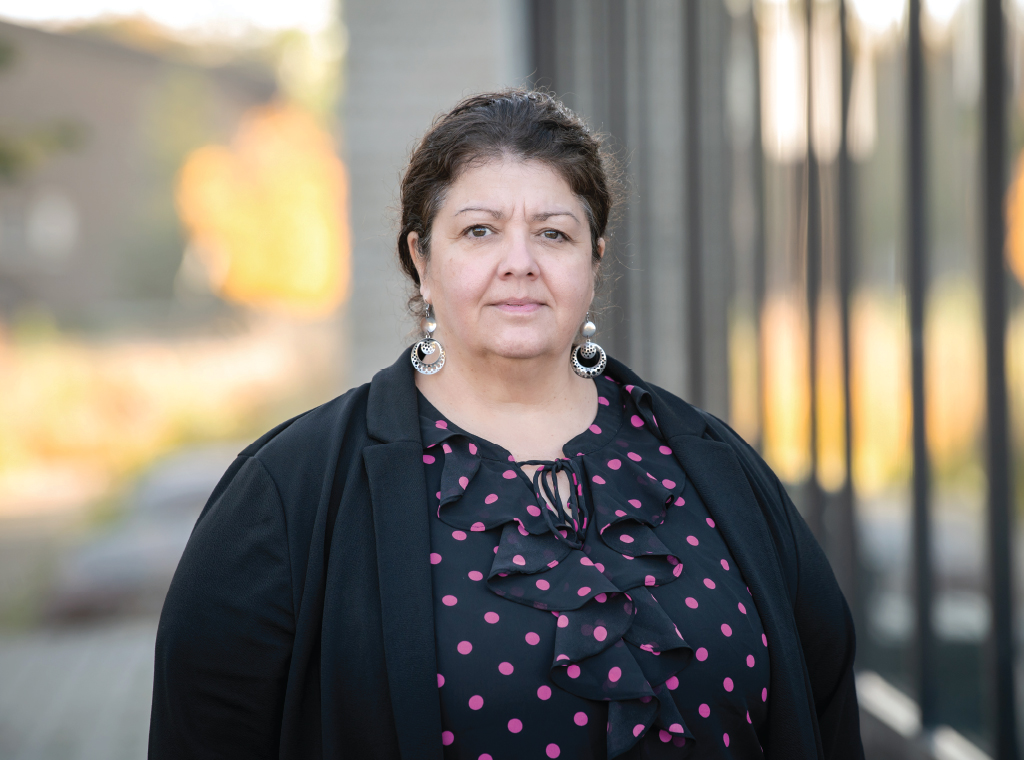
MTS President Lillian Klausen says violence in schools is not appearing out of nowhere.
Klausen added the situation reflects long-standing political decisions to underfund public education at a time of growing needs, resulting in school resources being increasingly stretched thin.
“What we are seeing in Manitoba classrooms is the result of years of political decisions that have left schools under-resourced and overstretched,” she said. “Educators are now dealing with the consequences of that neglect every single day.”
The Society is calling on the provincial government to establish a universal, province-wide system to track and report incidents of violence in schools, arguing that consistent data is needed to properly understand the scope of the issue and guide effective responses and to take immediate action to address staffing and resource gaps contributing to unsafe learning environments.
Klausen said the consequences of inaction extend beyond individual incidents and across entire school communities.
“Students are in the school system for as long as 12 years. If these behaviours are not properly addressed with the right supports early, they do not disappear—they continue and, in many cases, escalate over time.”
A survey of 3,370 public school educators conducted by Probe Research between Jan. 22 and Feb. 17, 2026 (±1.54%, 19 times out of 20) underscores those concerns, with teachers reporting rising levels of violence and increasing difficulty maintaining safe and functional classrooms.
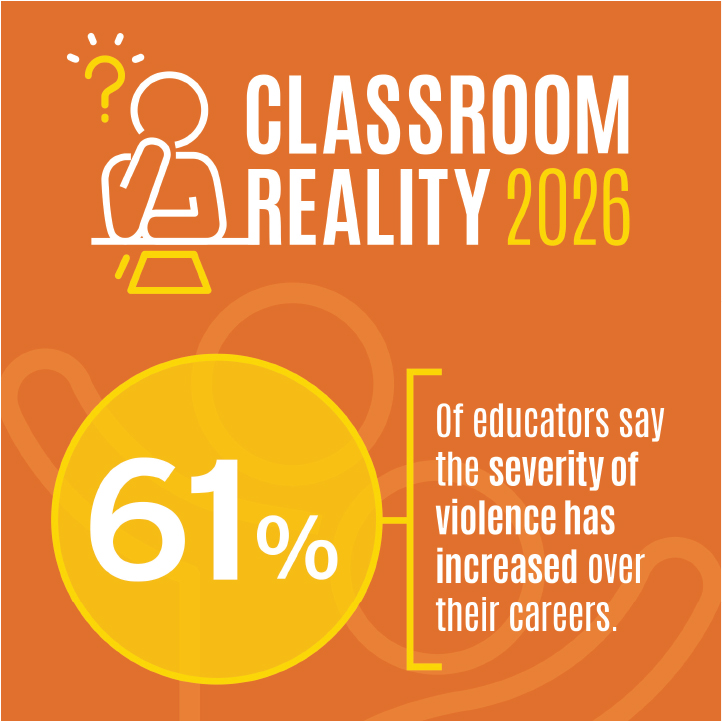
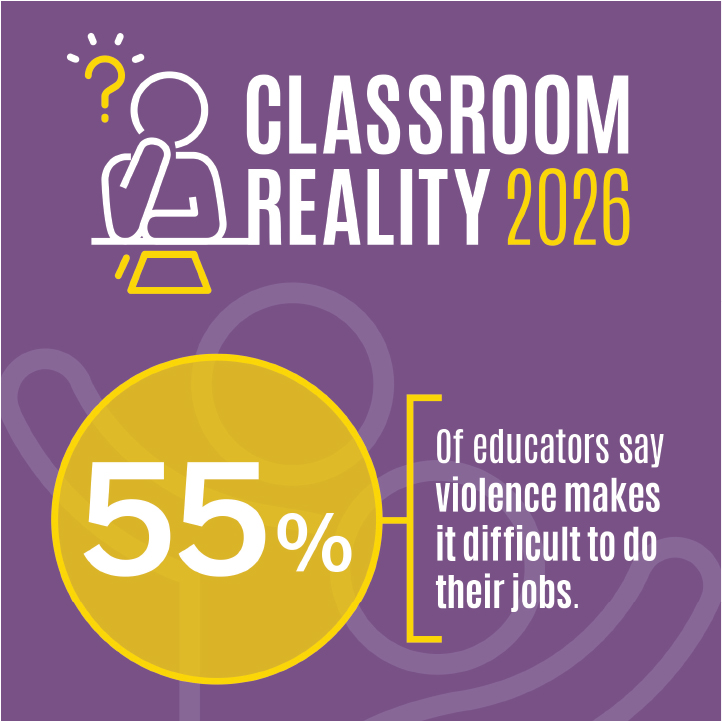
The survey found that 70 per cent (70%) of educators say violence has increased over their careers, 61 per cent (61%) say the severity has increased, 46 per cent (46%) say it is a serious problem in schools, and 55 per cent (55%) say it makes it difficult to do their jobs.
Violence in the classroom is also being cited as a key factor driving teachers to consider leaving the profession. A total of 42 per cent (42%) say they plan to leave before retirement, mentioning violence and the lack of support as reasons.
Recent national data provided by the Canadian Teachers’ Federation (CTF/FCE) reveals that 94 per cent (94%) of teacher organizations are dissatisfied with existing protections, 75 per cent (75%) report no follow-up after incidents are reported, 55 per cent (55%) of educators experienced violence or aggression in the last school year, and 41 per cent (41%) of educators do not feel they have a safe work environment.
Violence and Harassment in Schools: An Educator’s Guide
Workplace violence is any use or attempted use of physical force that could cause injury and can come from students, parents or guardians, visitors, coworkers or anyone else in the workplace. It doesn’t have to result in an injury to be considered workplace violence.
In a school setting, workplace violence may include:
- Hitting, kicking, biting or punching
- Throwing objects
- Pushing or shoving
- Physical intimidation
- Attempts to physically assault someone
Workplace harassment is unwanted behaviour that creates an unsafe, intimidating or unhealthy work environment. Harassment is often repeated, but one serious incident can also be considered harassment.
Harassment may include:
- Bullying
- Threats or intimidation
- Repeated insults or humiliation
- Offensive jokes or comments
- Discrimination based on protected characteristics
- Abuse of authority or power
What Should I do if I Experience Violence or Harassment?
Your safety comes first. If there is an immediate risk of harm, contact emergency services.
Once it is safe to do so:
- Report the incident as soon as possible.
- Record what happened, including dates, times, locations and witnesses.
- Follow your workplace reporting procedures.
- Contact MTS if you need support.
- Seek medical or psychological care if needed.
What if a Student is Violent?
Violence from a student should never be dismissed simply because of the student’s age or exceptional learning needs.
Incidents should be reported, documented and addressed according to workplace procedures.
Every reported incident helps identify risks and improve safety for everyone.
Why Reporting Matters
In 2024, Society staff recorded 164 workplace safety and health-related calls from members. In 2025, that number increased to 233. So far in 2026, 144 calls had already been logged, as of early July.
While these numbers provide some insight into the issue, they represent only a portion of what teachers may be experiencing.
“It’s important for us to keep in mind that these are just the members who contact The Society for help,” said Tammy Hodgins-Rector, Teacher Welfare Staff Officer. “We know many others don’t call, or sometimes one teacher will call on behalf of several colleagues who are experiencing the same situation.”
In Manitoba, Workplace Safety and Health is built on an internal responsibility system. This means that everyone has a role in the prevention of workplace violence.
Any teacher experiencing violence, harassment or other workplace concerns are encouraged to report the incident through their school division’s reporting system and reach out to their local association or The Society for support. The Society can support members with completing reporting forms, connecting with Disability Benefits Plan (DBP) if needed, advice before attending an investigation meeting, support during the investigation meeting, and potentially legal support resources. The Society also offers in person and virtual Workplace Safety and Health training.
“We can help make sure the right steps are taken and connect members with the supports they need,” Hodgins-Rector added.
By working collaboratively across departments and listening closely to members, The Society is continuing to explore ways to address violence in schools while advocating for safer workplaces for all educators.
A resolution passed during The Society’s 107th Annual General Meeting of Provincial Council in May calls on MTS to advocate for members’ safety in schools by creating an advertising campaign that highlights the increased incidences of violence occurring in schools.
Beyond the virtual and in-person workplace safety and health training The Society already offers across the province, staff will be offering provincial training focused on violence for local association presidents this fall. The Society is also developing a new provincial reporting app that is being piloted by school divisions this fall.
A Growing Concern in Manitoba Schools
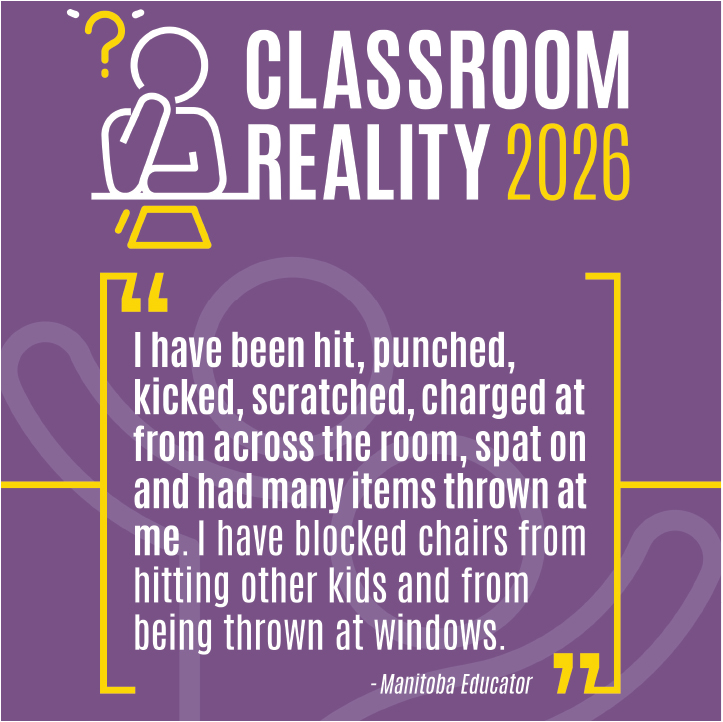
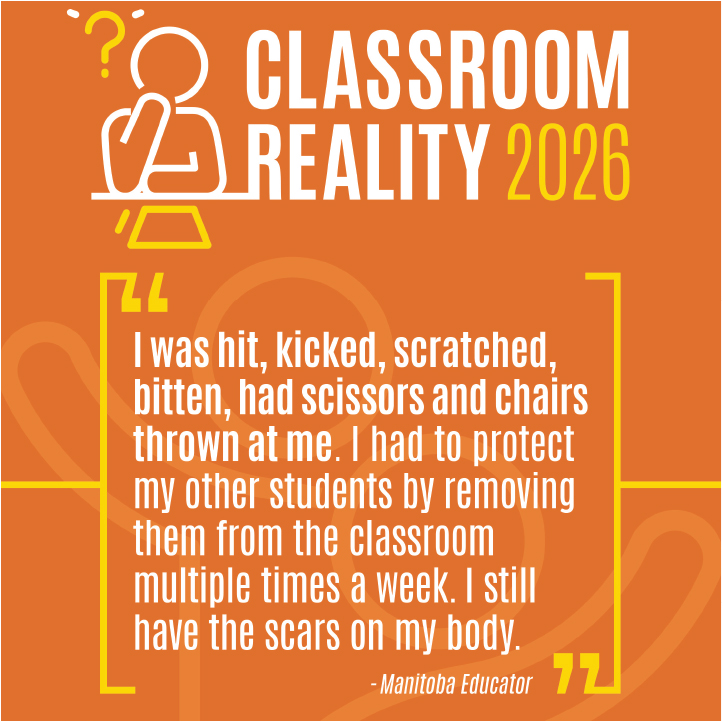
Manitoba teachers describe being hit, kicked, bitten, screamed at, and verbally abused, often starting in early years. Many feel incident reporting leads nowhere and that policies around seclusion, restraint, and suspension restrict their ability to keep people safe.
There is also a sense that violence and extreme dysregulation have become normalized, with significant emotional impact on both staff and students.
View all our posts here.
Educators stress that the impact of violence is not limited to those directly involved. Students who witness violent incidents are also affected, with learning disrupted and classroom environments becoming less stable and less safe for everyone present.
As one teacher put it: “The onus is usually on teachers to stand by while kids rage. We do our best to keep the other kids safe from physical harm, but the mental and emotional harm of having to witness these things isn’t addressed.”
Teachers say this has a cumulative effect on student well-being, reinforcing the need for earlier intervention and stronger in-school supports.
Numerous educators’ written responses describe increasingly serious situations in schools, including repeated lockdowns, weapons being brought into schools, and escalating physical incidents.
One survey respondent described multiple serious violent events over their career, including weapons seizures and repeated emergency lockdowns, while others said violence has become so routine it is simply part of the job.
At the same time, more than half of educators report that access to student supports has declined over the course of their careers, with many pointing to reduced special education capacity and growing unmet student needs.
Klausen said teachers are increasingly being placed in situations that raise fundamental concerns about workplace safety and system responsibility.
“Teachers have the right to a safe workplace,” she said. “That has to be recognized as a non-negotiable condition of the public education system. At the same time, students have a right to education, but that cannot be meaningfully achieved in environments where safety is consistently compromised. Both require the system to function properly.”
She added that current conditions are no longer sustainable. “Teachers are being asked to manage increasingly complex and dangerous situations without the resources required to do so safely. That is not sustainable, and it is not acceptable.”
The Lasting Impact of Violence
The impact of violence can extend far beyond immediate physical injuries, it can accumulate over time, affect an educator’s ability to work, break trust and leave lasting psychological and physical impacts. Some may experience physical injuries ranging from bruises and strains to serious head injuries that can have lasting effects. Others experience psychological trauma that makes returning to the classroom difficult or, in some cases, impossible.
“Everybody involved in these situations is often doing their very best and it’s still not working and people are getting hurt,” Streich said.
For many, the effects build over time. Repeated exposure to violent incidents can lead to what is known as cumulative trauma, Streich explains. The impact is also complicated by the fact that these educators want to remain in the classroom. They worry about their students, the relationships they have built and what could happen in their absence.
“Anytime you are involved with something like this, it’s very layered,” Streich said. “There’s all sorts of physical and psychological ramifications that can stay with you.”
How MTS is Supporting Members
In response to a rise in calls about violence from members, The Society has established an Addressing Violence in the Workplace Working Group to better understand the issue and coordinate a strategic response and recommendations. The group brings together staff from several departments to examine trends, support members and explore ways The Society can help its members address violence in schools.
Another aspect of the committee’s work involves recent changes to Manitoba’s Workplace Safety and Health Act. Amendments introduced in 2024 now recognize psychological health and safety as part of workplace safety legislation. The changes mean that certain sectors, including education, will be required to conduct psychological health and safety assessments of their workplaces once supporting regulations are finalized.
For educators, this recognition is significant. It acknowledges that a safe workplace involves not only physical safety, but also an environment where employees feel comfortable raising concerns and having honest conversations about their working conditions.
The violence committee is examining how these legislative changes may affect teachers, while also working closely with other Society initiatives focused on psychological health and safety.
Ultimately, the goal is to ensure members have the information, support and resources they need when difficult situations arise.
Violent Incident Reporting Resources
The Society has created the following documents to help better understand violent incident reporting and investigations in the workplace:
- Violent Incident Reporting and Investigations
- Guiding Principles for Reporting
- Manitoba Workplace Safety and Health Act and Regulation
- Workplace Violence and Harassment Toolkit
If you require assistance with a Workplace Safety and Health concern, contact a Teacher Welfare Staff Officer at 204-831-3055 or 1-800-262-8803.
If you have been impacted by violence at work, you can access support through the Disability Benefits Plan (DBP). For general inquiries, please call 204-957-5330.