

Back to School: Navigating the Teacher Regulation Process
Manitoba’s teacher regulation framework has changed the way professional conduct concerns are addressed, introducing a new Commissioner of Teacher Professional Conduct, expanded reporting requirements, competency standards, and a public teacher registry. As educators adjust to this evolving landscape, The Manitoba Teachers’ Society is helping members understand what these changes mean and where to turn for support.
In January 2025, Manitoba implemented a new teacher certification and professional conduct framework in alignment with changes to The Education Administration Act, that introduced new oversight, reporting requirements and accountability measures for the profession.
This legislative framework resulted in an office of the Commissioner of Teacher Professional Conduct, introduced provincial competency standards, and launched a public Teacher Registry. Together, these changes are intended to strengthen public confidence in the teaching profession while creating a consistent process for addressing concerns about professional misconduct and competence.
The public Teacher Registry contains the name, certificate classification and certificate status of every certified Manitoba teacher dating back to 1960. The registry also includes disciplinary outcomes, with misconduct decisions remaining publicly available indefinitely. A separate disciplinary outcomes list includes decisions dating back to 1990.
As of May 2026, Noni Classen is the Commissioner of Teacher Professional Conduct for Manitoba and is responsible for receiving complaints about teachers regarding their conduct and competency.
School divisions maintain their responsibilities when it comes to setting expectations for conduct and determining teacher competence. The new disciplinary model does not replace the obligation on the employer to investigate concerns of misconduct or incompetence. However, the legislation stipulates that the employer must report all discipline for professional misconduct and/or incompetence to the commissioner.
Anyone can file a written complaint alleging professional misconduct or incompetence. Complaints can also be submitted anonymously.
What is Teacher Professional Misconduct?
According to the Manitoba Commissioner of Teacher Professional Conduct 2024/25 Annual Report, teacher professional misconduct is broadly defined as “conduct that makes someone unsuitable to continue to be a teacher.”
Misconduct includes, but is not limited to:
- sexual or physical abuse of a pupil or child,
- emotional harm to children,
- any act prohibited under section 163.1 of the Criminal Code (Canada) (child pornography), and
- other conduct that undermines the integrity of the teaching profession—whether inside or outside the classroom.
How are Complaints Reported?
There are several ways complaints or concerns about a teacher’s professional conduct can be brought to the commissioner’s attention. Since Jan. 6, 2025, all employers of certified teachers, including public and independent schools, First Nations education authorities, institutional and international schools, and adult learning centres, are legally required to report certain serious matters right away. These include charges or convictions involving child abuse, disciplinary action for professional misconduct, and resignations where reporting is considered to be in the public interest. Employers may also submit complaints about other professional conduct concerns.
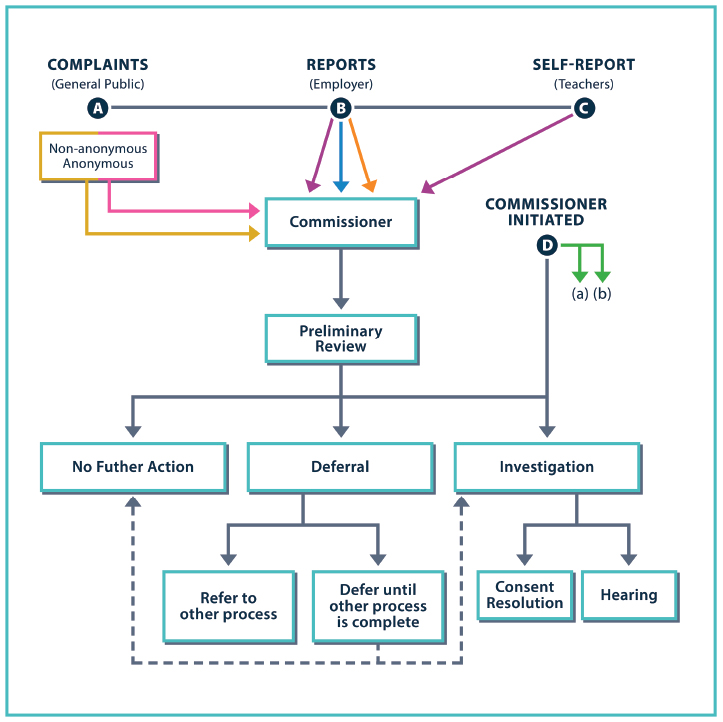
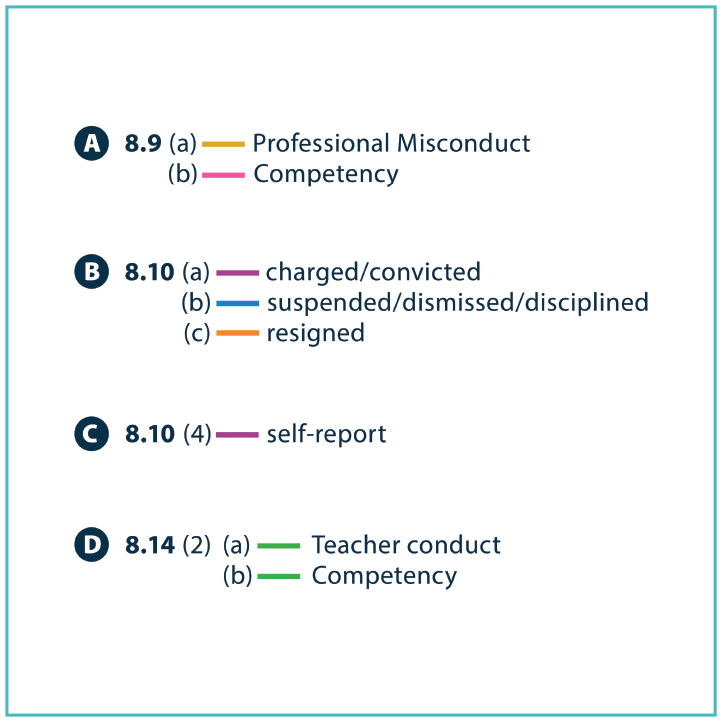
Educators also have a legal duty to self-report if they are charged with or convicted of an offence involving the sexual or physical abuse of a child. Any member of the public can also file a complaint alleging professional misconduct, and the commissioner has the authority to launch an investigation independently if information about a potential concern comes to light through other sources.
How are Complaints Managed?
When a complaint or report is received, the commissioner begins with a preliminary review. At this stage, the commissioner may decide no further action is needed, launch a formal investigation, or pause the process while another related matter is resolved. In situations where student safety may be at risk, the commissioner also has the authority to temporarily suspend a teacher’s certificate while the process is underway.
If an investigation is launched, the teacher, the person who made the complaint, and the teacher’s employer are notified. The commissioner has the legal authority to gather evidence, require documents, and interview witnesses before deciding what happens next. Following the investigation, the matter may be closed, resolved through a consent resolution agreement between the commissioner and the teacher, or referred to an independent hearing panel.
If a hearing is required, a three-member panel hears the evidence and determines whether professional misconduct occurred or whether the teacher is unable to carry out their professional duties because of a disability. The panel may dismiss the matter or impose consequences, with, along with consent resolution agreements and any restrictions on a teaching certificate, are published on Manitoba’s teacher discipline registry. Teachers also have the right to appeal a hearing panel’s decision to the Court of King’s Bench, providing an additional safeguard to help ensure the process is fair, transparent, and accountable.
Since January 2025, the commissioner has received 94 cases, with 23 reaching resolution.
How MTS is Supporting Members

Teacher Welfare Department Staff Officers Tim Breen and Andrea Zaroda are helping lead The Society’s work to support members as Manitoba’s teacher regulation framework continues to evolve.
As Manitoba’s teacher regulation framework continues to evolve, The Society is putting into action recommendations developed by its former Teacher Regulation Inter-Departmental Committee, an internal group established to help The Society’s response to the new regulatory landscape. This work has helped strengthen member supports, refined internal processes and improved coordination across departments.
“We are here to support members through this change in the system. It’s all about guiding teachers and advocating on their behalf,” said Staff Officer Andrea Zaroda. “This framework impacts teachers every single day and it’s really woven into the work that we do here at The Society.”
Today, staff across the organization continue to monitor legal, operational and member support implications while adapting processes as the regulatory framework evolves.
“Information is power, which is why we continue to provide clear, accessible resources, workshops and guidance to help members understand this process and know how to respond if they ever need to,” Zaroda said. “Most teachers will never encounter this process, but we want to bring clarity to what can be a very public and highly stressful process.”
The Society’s work includes refining internal workflows, expanding member resources and identifying where additional supports are needed.
“Teachers are now part of a more regulated profession than they’ve ever been before and that requires new processes and supports,” said Staff Officer Tim Breen.
The goal of this framework is to protect the public and ensure that there is trust in the profession that is being regulated, Breen added. Because the regulatory system is still relatively new, many of its processes continue to evolve.
“There isn’t a template we can simply follow,” Breen added. “We’re learning in real time and adapting as new situations arise.”
Currently, dozens of Manitoba teachers are involved in the commissioner process at various stages. It’s important to note that The Society is only involved if the certificate holder is a member and explicitly requests representation and members are under no obligation to involve The Society. These cases often require significant time and coordination as procedures continue to develop.
To support this work, Society staff have established regular communication channels with the commissioner’s office to address emerging issues, share feedback and improve processes as they develop. Staff also monitor legislative developments, new regulations and updates to the public registry to ensure members receive timely, accurate information.
The Society continues to advocate on behalf of members with the commissioner and the government of Manitoba to ensure that the process is fair, provides members with due process, and balances these factors with the regulator’s responsibility for public protection.
“It’s not just about a specific job or employer,” Breen added. “In some cases, the outcome could affect someone’s ability to teach anywhere in the province.”
Members navigating this process have access to a range of supports through The Society, including legal representation and mental health resources through Kii. A dedicated email address: regulation@mbteach.org has also been created for members who have questions about the process.
Education remains a key priority. As many teachers are still unfamiliar with the new framework, Society staff continue to deliver presentations to locals and divisions across Manitoba to help ensure members understand how the process works and where they can turn for support.
“Teacher regulation is designed to protect the public,” Breen added. “But our role is to ensure members understand the process, have the support they need to navigate it and receive fair representation along the way.”
Explore Resources
The Society has created the following resources to help better understand the Commissioner for Teacher Professional Conduct process and how it could impact you:
- Graphic representation of the Commissioner Process
- Teacher Regulation FAQs
- Understanding the New Competency Standards for Teachers FAQs
Information about the commissioner’s rules and procedures can be found here. As well as an explanation of the complaint management process and frequently asked questions.
The Manitoba Commissioner of Teacher Professional Conduct 2025/26 Annual Report can also be found here.
If you have received a letter from the Commissioner indicating you are the subject of a complaint, please contact The Manitoba Teachers’ Society at 204-888-7961 to speak with a Staff Officer in Teacher Welfare.
If you are not a subject of a complaint but have questions about the Teacher Professional Conduct process, please contact regulation@mbteach.org